
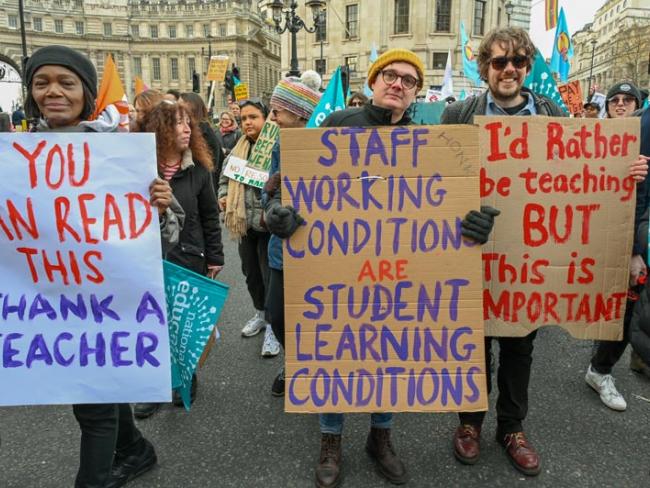
Teachers marching in London during their 2023 campaign. Now the National Education Union is to hold a ballot on new action. Photo Ajit Wick/shutterstock.com.
Teachers in England may soon take action over their pay and conditions. The first step was an indicative ballot of members, which closed on 17 April. The result was overwhelming, with 96 per cent voting to reject the current government offer, and 90.5 per cent ready to take industrial action. Turnout was 48.6 per cent.
In the indicative ballot, the National Education Union asked members whether they would be willing to strike over school funding, teacher pay and workload. The union’s rules stipulate that before a formal ballot for industrial action, they must undertake “an indicative survey of members showing that such a ballot is likely to be successful”.
As yet teachers have not been in dispute with this Labour government over pay. But depending on the follow up to the indicative ballot, teachers could soon be joining other workers in industrial action to demand a pay rise.
Currently the government proposes a 6.5 per cent pay rise for teachers spread over three years. Even before the recent jump in oil prices, this offer was unlikely to match the rate of inflation over the period. And it did nothing to redress the average 20 per cent loss in real-terms pay for teachers since 2010. School support staff have suffered a greater fall, of around 26 per cent in that time.
There are wider concerns for schools. Any award will not be funded but will come from existing school budgets. This will make even more reductions in school funding inevitable – leading to fewer staff, more work and poorer quality education. And if that was not enough, the government is also proposing to get rid of the limit of 1,265 hours each year when teachers can be directed to be at work – known as directed time.