
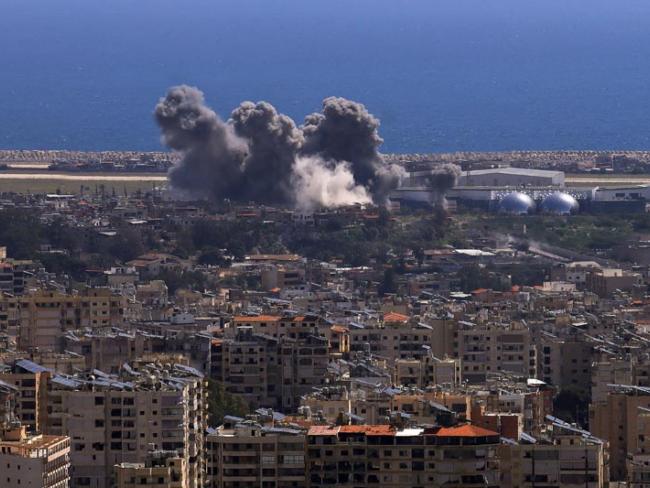
11 April 2026: smoke rises following an Israeli strike on the southern suburbs of Beirut. Photo mytaj/shutterstock.com.
A recent CPBML meeting discussed how workers here can respond to foreign wars. One conclusion: removing Britain from the crumbling NATO alliance would be a good start…
War in the Middle East – presently in Iran, Lebanon and Gaza – appals most people in Britain. But there is little agreement on what can be done.
The reality is that the British government and ruling class are entangled with the US in these aggressive adventures. That needs to change.
We could ditch the crumbling NATO alliance and end Britain’s involvement in foreign wars. Then we could fully exploit Britain’s energy potential, build our own defensive capabilities and so on.
Britain could be far more self-reliant politically and industrially. To make that happen, the British working class must take charge. But what does this mean and how can we bring this about?
Self-reliance depends on British independence and more. Importing gas and oil when we have our own gas and oil fields is not self-reliance. And the problem is that under capitalism self-reliance is always at risk.
Nothing ‘special’
First, let’s look at Britain and the USA. There is no such thing as a “special relationship”, and there never has been. The reality is that the US demands that Britain as a NATO ally does as it is told. There is nothing particularly special about that. And this is definitely not in the interests of the British working class – no matter who the US president is or who forms the UK government.
‘The problem is that under capitalism self-reliance is always at risk…’
Secondly, what does Britain have to do with the Middle East? This huge region has a history of wars and internal conflicts. And worse, imperialists – Britain, the USA and others – have for over a century often intervened in their own economic interests.
The foreign exploitation is now dominated by the need for oil. It is often dressed up in other guises but always seeks to divide and subjugate the peoples of the area.
The 2003 invasion of Iraq, fully supported by the Blair Labour government, was declared necessary because they had “weapons of mass destruction” that were never found.
The Chilcot report into the Iraq war eventually come out in July 2016, when the Leave referendum result dominated news. It trashed just about all Blair’s policy announcements and justifications.
This brings us to more recent events. The US and Israel started to bomb Iran this February – in violation of the UN Charter and without a Security Council resolution. Their war of aggression has no legal basis.
Pretext
The pretext for this war was to destroy Iran’s missile programme and to bring about regime change. Neither has happened. Misinformation abounds.
The US also claimed that its actions would stop Iran developing nuclear weapons, although there is no proof that it is doing so. Iran has signed the Non-Proliferation Treaty for nuclear weapons. Israel has not – it has its own nuclear weapons but won’t admit it.
At the emergency UN Security Council meeting on Iran, the US attempted to justify the war using ancient Security Council resolutions, a sign of desperation. Iran’s Ambassador said, “True to a regrettable pattern the United States has attempted to distort facts and rely on misinformation to justify the blatant aggression.”
The US and Israel expected Iran to collapse within a short time. Iran did not, despite assassinations of leaders, and continues to resist.
So what should our response in Britain be to the US and Israeli attacks on Iran? And to the Israeli government’s brutal bombing campaigns against Gaza and Lebanon?
As British workers, we can only influence what happens in Britain. There is opposition here to wars in the Middle East, but as yet little direct questioning of the adherence to NATO and the USA.
But it is Britain where focus in needed. There is little or no support evident in Britain for increased costs arising from the war – dearer fuel increases the cost of living all round. Workers protest and fight against rising costs and inflation, but that does not go as far as tackling the causes.
Does opposing NATO and wars abroad mean we are against defending Britain? Certainly not! But to defend Britain there is no need to engage in foreign wars or to finance them.
Staying out?
Starmer declares he will stay out of the Iran war. Yet he agrees (eventually) that the US can use its air bases here to attack Iran. He sends Royal Navy ships to the area. British jets shoot down missiles and drones over the Middle East claiming that protects British and allied assets.
Britain retains armed forces deployed across the Middle East – with bases in Bahrain, Oman, Qatar, the United Arab Emirates and Cyprus.
The government constantly says there is not enough money for what is needed in Britain. We have a cost of living crisis while the government spends billions on wars and supporting wars.
War abroad and war on workers at home go together. There is never a shortage of money for war.
Lacking the support of the British people, the government talks up the threat of Iran and Russia, urging national unity in the face of external threats.
It’s not going to be enough to fight for better wages to counter rising costs here. Our working class needs to tell Starmer, and anyone who follows him, to get out of wars everywhere and to stop financing countries that are involved in wars. That means distancing Britain from the US government, and the EU, by calling for us to leave NATO.
Such calls would be a start in taking charge of Britain’s involvement with the rest of the world. It would challenge politicians and the ruling class who would have us believe we have no power or influence.
Why is our working class so reluctant to get out of NATO – or even to ask the question whether we should? Do we believe it is possible to defend ourselves outside NATO? Apparently not – or not yet.
Shut the bases
Only by leaving NATO can we demand that US bases here are closed and US forces are told to leave. The US will be furious of course: it never likes being told what to do and believes only in its own sovereignty, no one else’s.
Britain was most influential in the formation of NATO (notably promoted by Ernest Bevin, former trade union leader, foreign minister in the post war Attlee Labour government and ardent anti-communist). Why should we not be just as influential in leaving NATO?
Does a focus on Britain mean ignoring wars elsewhere? Certainly not!
We say that war is inherent to capitalism, and it is impossible to have capitalism without war. Marching against war without challenging the causes of war, without challenging capitalism in its homeland, will not achieve change. And sectarian marching for one side or another in a foreign war will set back the unity of the British working class.
To move forward against war and for the future of Britain will mean the British working class deciding that it will no longer live with capitalism but will reject it.
Once question of the necessity or inevitability of capitalism is on the agenda in Britain, we will have a new direction, and we will be starting to take charge.
Bringing this about can’t happen without struggle and debate. A clear and determined response to the current drive to war can help to create the climate where such progress is possible.