
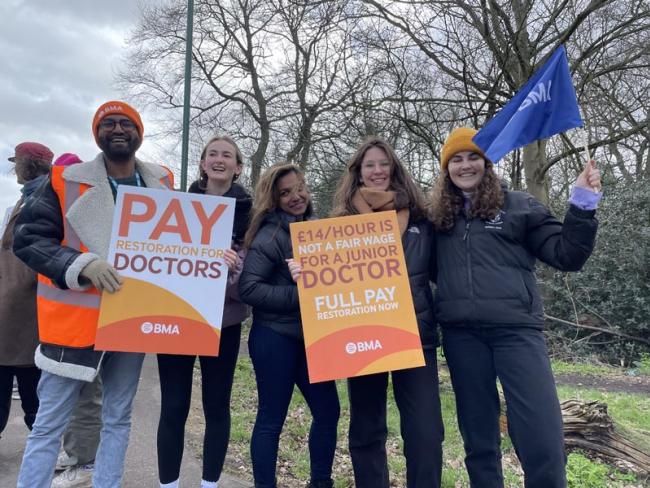
Doctors picketing at Whipps Cross University Hospital, London, during an earlier round of industrial action. Photo Workers.
Resident doctors in England are taking industrial action again over pay and jobs. A six-day strike began on 7 April, their fifteenth strike since March 2023. There is no end in sight to this bitter dispute.
The current action was called after a ballot of the resident hospital doctors (formerly called “junior”). Over 93 per cent voted for it, though the turnout of 53 per cent was lower than for the ballot prior to last year’s strike.
The government made an offer of 3.5 per cent in March – below RPI inflation (currently 3.6 per cent). The offer was seen as risible, ignoring years of low pay increases. The BMA has been demanding pay restoration for doctors, who have suffered cuts in real terms of 20 per cent since 2008. Health secretary Wes Streeting then withdrew his offer of 1,000 extra training posts the BMA were demanding, a deliberate provocation.
In response to the strike, the Chief Executive of NHS England, Sir Jim Mackey, said the NHS will design clinical models that are less reliant on resident doctors. He denied he was making a threat, but also claimed services had run more smoothly during the strikes, when consultants and other clinicians had filled in for resident doctors.
As the dispute became more bitter, the BMA announced a ballot of its consultant and other senior doctor members on strike action, over their 3.5 per cent pay award. They also have seen erosion of their pay in real terms since 2008.