
23 June 2026
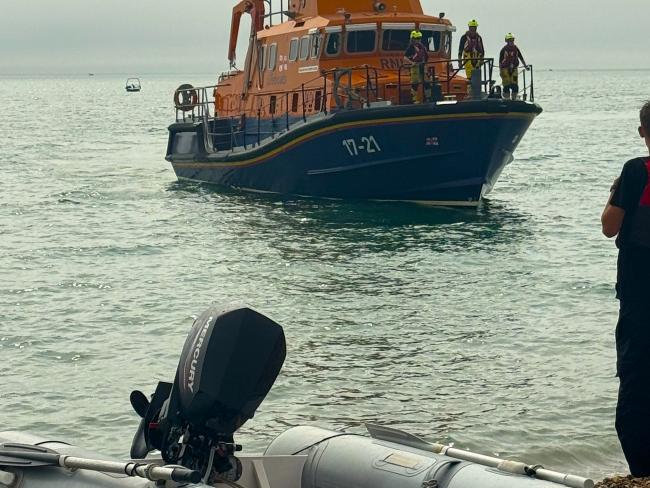
A Severn class RNLI lifeboat crew demonstrating rescue techniques at a Sussex beach, June 2026. Photo Workers.
The Royal National Lifeboat Institution (RNLI) plans to close its facility in East Cowes on the Isle of Wight. Workers there are fighting to keep their skilled jobs – and for union recognition.
The closure, announced in May, was accompanied by a refusal to recognise the Unite trade union, to which workers at the centre belong. Workers are now balloting on strike action for recognition.
Highly skilled
The Inshore Lifeboat Centre employs around 70 people. It carries out highly skilled work supplying and maintaining the RNLI’s fleet of lifeboats at half their 238 stations around the country.
Workers at the centre maintain the inflatable B and D class lifeboats and inshore rescue boards. The RNLI acknowledges these craft are increasingly important as patterns of coastal use change.
Growth
Many more lifeboat rescues are carried out in inshore waters than in the past. This is due to the grown in popularity of recreational activity such as open water swimming, windsurfing and paddleboarding.
For over sixty years the Island has been an important base for the RNLI. But by 2028 the work will be relocated to Poole, Dorset, on the mainland.
Bitter
Island residents are bitter about the RNLI’s decision and point out the contradiction with the organisation’s humanitarian principles. A petition in support of the workers is gathering widespread support.
‘Closures have left workers in the Island reliant on seasonal employment in tourism.’
The Isle of Wight was once a centre for British marine and aerospace engineering. Now closures and redundancies have left workers there reliant on seasonal employment in tourism, and the country beholden to foreign capitalists for the supply of these commodities.
One of the most notable casualties was the Vestas wind turbine factory in Newport, the only one in Britain (though it is Danish-owned). Production stopped in 2009 with the loss of over 500 jobs, despite a sit-in by workers.
Blade manufacturing restarted in 2015 but by 2024 was under threat again. A government grant earlier this year secured around 300 jobs at the site, about half the workforce.