
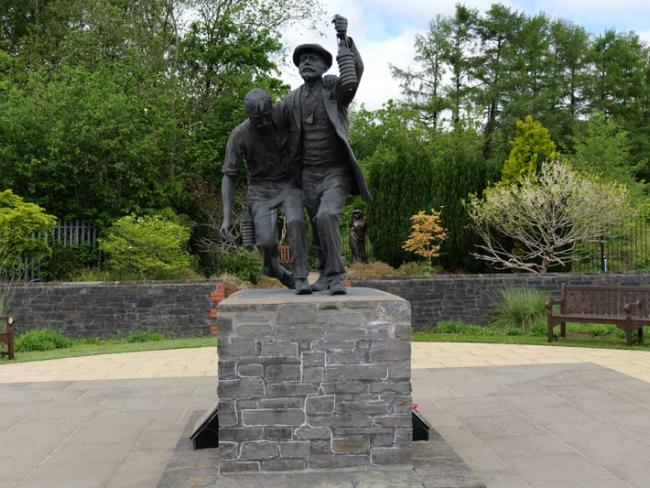
Welsh National Mining Memorial and Universal Colliery Memorial Garden at Senghenydd,showing the statue, designed by sculptor Les Johnson, depicting a rescue worker coming to the aid of a survivor after a mining disaster. Photo Workers.
Mining has never been risk free. A year before the First World War, an explosion in a South Wales colliery led to Britain’s worst mining disaster…
Mining in British deep coal mines, now all closed, was hazardous even in later mechanised pits. Over a hundred years ago, mining in deep coal mines was positively dangerous.
There were over 100,000 deaths in British mines between 1900 and 2000, over 84,000 of them before 1950. In Wales this included the explosions at Senghenydd in 1913 which killed 440 people, Gresford in 1934 where 261 perished and Six Bells in 1960 where 45 lost their lives. Yet such incidents accounted for only a small percentage of the total mine-related deaths.
Also coal-related was the Aberfan disaster in 1966. A coal spoil tip collapsed with the resultant slurry hitting the school as well as cottages and houses – 116 children and 28 adults died.
At about 8am on 14 October 1913 at Senghenydd Universal Colliery in the Aber valley in south Wales there was an explosion in the west side of the mine. 439 miners died, including eight boys aged 14, and one rescuer was killed by a rockfall.
Spark
This was the worst disaster in British mining history. The explosion was probably caused by a spark, perhaps from electric signalling gear. This ignited methane gas (or firedamp as it was known). The explosion caused coal dust lying on the floor of the mine to rise; this also caught fire and exploded. The shock wave promptly caused more coal dust to rise into the air and this also then ignited.
The fires spread through most of the west side underground workings, quickly followed by afterdamp. This consists of various gases formed by the explosion, including asphyxiants like carbon dioxide and nitrogen as well as poisonous carbon monoxide. Miners who had escaped the explosion would be suffocated due to lack of oxygen unless they could quickly get to the surface or somewhere safe.
Hampered
Rescue teams from other valleys arrived at the scene but attempts to get the men out were hampered by fallen debris, by a series of roof falls and by raging fires. When a rescuer was caught and killed in one of these roof falls, still the other rescuers worked on.
And they did find 18 men and boys still alive in the wreckage. But as the days wore on, survivors grew fewer and carrying out bodies became the norm. The rescue attempts lasted for three weeks although, by then, the chances of finding anyone alive had long since gone.
Both the manager and owners of the Universal Colliery Company were subsequently prosecuted. The £24 fine imposed on the manager produced the headline “Miners’ Lives at 1s 1¼d” – the equivalent of around £12 per death today. After court challenges the owners were eventually fined £10 with £5 5s costs – a paltry £2,250 in today’s money!
Universal Colliery was back in use by the end of November 1913: full production was again achieved by 1916. The mine was later closed, however, with workmen and staff being given just one day’s notice of closure in March 1928.
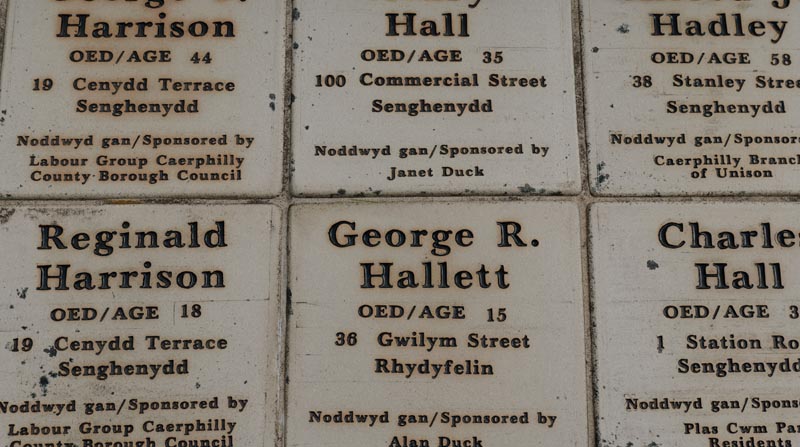
Until recently there were few memorials to the men and boys who lost their lives at Senghenydd. No memorial was unveiled until 1981 (by the National Coal Board). But in October 2013 on the 100th anniversary of the disaster a Welsh National Mining Memorial and Universal Colliery Memorial Garden was opened in Senghenydd.
This disaster did not come out of the blue. Twelve years earlier, on 24 May 1901, the same colliery had experienced its first disaster. At 5am on that day an explosion killed 81 men on night shift and 50 horses. Just one man and two horses survived.
“My father always said there was more fuss if a horse was killed underground than if a man was killed…”
A miner who survived the 1913 explosion later said, “My father always said there was more fuss if a horse was killed underground than if a man was killed. Men came cheap – they had to buy horses.”
Despite recommendations made by the inquiry into the 1901 explosion, and evidence that the Senghenydd pit was dangerously dry, dusty and gas-prone, production continued to expand, reaching 1,800 tons a day by 1913.
The Coal Mines Act 1911 collected together a number of regulations for safe working learned from bitter experience. The act covered control of electrical equipment to prevent sparking, and watering of dusty areas. It also said mines needed to have reversible fans so that clean air could be provided in the case of emergencies.
This law demanded that the fans be reversible by 1 January 1913. The mine owners at Senghenydd asked for and secured approval to extend until 16 September 1913 to implement changes to allow the fans to reverse. This was further extended to 30 September 1913.
Safety failings
At the time of the 1913 explosion, the fans were still not capable of being reversed at Senghenydd. Other aspects of the Act were also not implemented. If the full terms of the legal regulations had been operational at Senghenydd by October 1913, there may well have been fewer deaths. There were no respirators at Senghenydd; the subsequent inquiry deemed that this failing cost lives.
The deaths at Senghenydd in 1913 took the unwanted title of worst disaster nearly half a century after the previous worst disaster – at Oaks Colliery, in Barnsley, Yorkshire, on 12 December 1866, when 361 workers died in two separate explosions.